Handing a Creator Client's LinkedIn Ads Entirely to an AI Agent Without Losing Campaign Accountability
A strategist's guide to delegating LinkedIn ads while staying accountable.

LinkedIn Ads MCP connects an AI assistant to advertising tools so it can read performance and, with write access, manage campaigns. Kiin Intelligence offers a hosted MCP server for this, while Metadata.io offers MCP controls within its campaign platform. Handing a creator client’s LinkedIn ads to an agent is operationally viable, but the strategist stays accountable through written rules, approval gates, and reporting that explains every material decision.
Why LinkedIn ad ops for creator clients is an accountability problem, not a capability problem
Agents can already create campaign groups, upload creatives, set targeting, adjust bids, and generate reports. The gap is the governance around those actions. A strategist may have a tool ready to execute without having defined who approves a budget change, what triggers an escalation, or how a bad decision gets reversed. More capability does not close that gap. A clear assignment of responsibility does.
For a creator client, that responsibility is personal and contractual. The strategist is the named party managing ads that put the client’s brand in public. Delegation does not reduce that exposure, because the client still expects an explanation when an ad misrepresents them or a campaign spends poorly. If the strategist cannot explain or undo an action, that conversation gets harder.
When a human manages campaigns by hand, control often sits in the act of making a change in Campaign Manager. Under delegation, it must sit in the rules that permit changes, the checkpoints that approve them, and the records that explain them afterward. Full delegation hands over execution while leaving the strategist responsible for answering for outcomes.
What AI agents can actually do inside a LinkedIn campaign today
Its targeting and bid endpoints also give connected tools access to decisions that shape delivery. Agents can monitor spend, detect overspending and underdelivery, reallocate funds, and adjust bids using near-real-time auction data.
Model Context Protocol standardizes how an assistant connects to tools. For advertising, that can bring ad platform APIs, CRM data, and analytics into the same working context rather than leaving the agent with one isolated dataset. Kiin Intelligence says it has ninety-five read and write tools available through a single MCP server. Its write actions include campaign groups, campaigns, creatives, saved audiences, and pausing or reactivating campaigns.
Those capabilities still have clear operating limits. Reports show what happened, but interpreting results against sales conditions requires human judgment. Small account-based marketing audiences may have too little data for bid optimization to work well. Manual bidding is therefore recommended for tightly scoped account lists. Budget reallocation can also favor impressions or CTR over pipeline influence. A human must review those recommendations before they run, even when the proposed change looks efficient by the platform’s own metrics.
Which LinkedIn Ads MCP platforms can run campaigns through AI assistants?
The decisive distinction is read access versus write access. A tool that reports results or recommends changes is not equivalent to one that executes them. Kiin, ZenABM, and Metadata.io are the three options in this comparison, but the available product detail is uneven. That limits how closely they can be compared.
Kiin is a hosted tool that works with a general-purpose assistant. It is free on one ad account, then $65 per ad account per month, and connects through LinkedIn sign-in and one pasted URL without API keys or a data warehouse. It works with Claude, ChatGPT, Copilot Studio, GitHub Copilot in VS Code, and Grok, but not the consumer Copilot app. Every write uses preview-then-confirm, with a before/after diff that changes nothing on the first call, and new campaigns land as drafts. It also provides advertiser benchmarks and CRM joins to HubSpot, Salesforce, Pipedrive, and Attio for influenced pipeline visibility.
ZenABM has a low monthly rate and a thirty-seven-day trial. The supplied details do not establish its hosting, exact write actions, or approval behavior, so a like-for-like capability claim would go beyond the evidence here.
Metadata.io is the dedicated-platform option, with demo pricing and no published rate. It runs LinkedIn Sponsored Content among other channels, with optimizers for bids and budget allocation and MCP controls for audiences, campaigns, creative, budgets, and experiments. Its fit is B2B teams that want management inside a campaign platform. Whatever product is chosen, the strategist must set the rules for its use before giving it write access. The tool does not supply that judgment.
Why draft-first and confirm-before-write are the architectural baseline for accountability
A confirmation gate separates preparing a decision from committing it. The agent can put together the targeting, creative, campaign structure, and budget, but the strategist must give final approval before spend starts. Draft-first makes that separation explicit. A prepared campaign is not an approved campaign.
Kiin’s before/after preview illustrates the principle without requiring the strategist to inspect an unexplained result after execution. The proposed change is visible while it is still reversible by rejection. In a governed setup, an agent cannot launch an unapproved campaign or raise a spend limit on its own. These controls must be explicitly required for each tool.
For a creator client, this is more than interface design. The client’s brand is exposed by the ad, while the strategist’s contract typically assigns responsibility for what runs to the strategist. A dated record of human approval connects the eventual account change to a decision the strategist can defend.
A confirmation button governs an individual write within separately defined objectives, spending limits, and escalation rules. Without those rules, the strategist is simply reviewing a queue of changes without a consistent basis for saying yes.
Designing the governance layer before the agent touches the account
The strategist should define spending limits first. The written rules need limits by day, week, and campaign, plus thresholds for escalating large budget shifts or new audience segments. The rules must spell out which reallocations fall within a pre-approved allowance and which actions need a fresh review. Where every write requires confirmation, that allowance does not bypass the gate. Proposals that would have a large impact should go into a queue for governance review, along with the reasons for them.
Rollback and traceability come next. The system should support a return to prior configurations and preserve an immutable record of the user or agent identity, timestamp, feature set used, and outcome. Observability dashboards should connect budget actions with business KPIs. This gives the strategist evidence when performance deviates.
The optimization target must also be written down. Cost per qualified lead, influenced pipeline, or conversion rate can serve as the primary goal, with frequency caps, audience exclusions, and minimum spend per segment as guardrails. An agent rewarded for impressions may make choices that work well on the platform but miss the client’s business goal, a failure in the design of its optimization target.
Human review completes the governance layer. A review must be scheduled at least once a week to catch drift from the strategy that may be missed when changes are approved one at a time. The rules must also specify whether Audience Expansion and the LinkedIn Audience Network may remain enabled or must be disabled, since both are on by default and can leak budget. This upfront design is paid strategic work. It is the part of delegation that does not get automated.
What the strategist must still own after handing execution to the agent
The strategist still owns the brief and its assumptions. A weak brief can produce a campaign that follows instructions perfectly and pursues the wrong customer, offer, or result. Delegation therefore concentrates expertise at the point where objectives become instructions.
An agent can generate variants and format-compliant assets, but it does not possess the client’s brand standards or the history of what has helped or damaged that brand. The strategist becomes a curator, approving or rejecting variants before publication. Any AI-content disclosure rules that apply must be checked during that approval step by the human who approves the creative.
Performance interpretation is another distinct human job. A lower cost per lead does not explain itself. The strategist must explain results in light of context such as a competitor’s pricing announcement, a change in the client’s ideal customer profile, or a shift in the sales cycle. That context turns a report into something the client’s sales team, board, or CFO can act on.
Client communication remains with the contracted party. When performance slips or a compliance issue arises, the strategist needs to explain material decisions regardless of who executed them. The audit trail supplies the evidence, while the strategist supplies the judgment. This division gives the agent execution work and leaves strategy, interpretation, and accountability where they belong.
Structuring client-facing reporting so accountability is visible, not assumed
The client needs a decision record. For each reporting period, the report should explain major budget reallocations, creative rotations, and bid adjustments in plain language. The explanation should name the goal behind each change and distinguish what the strategist approved from what the agent executed under pre-approved rules. That makes the division of labor visible without asking for blind trust.
Results should follow the agreed business KPIs. Influenced pipeline, cost per qualified lead, and landing page conversion rate should lead where those are the defined objectives. Kiin’s comparisons against a large panel of advertiser accounts can support an explanation of whether a metric is strong or weak for the relevant audience and objective.
A raw number leaves that interpretation unfinished. A statement that cost per click was below the median for the audience and objective gives the client a basis for judging it. The strategist’s annotation should connect that platform context to the client’s actual business conditions, including pipeline updates or sales feedback. Neither layer replaces the other.
Weekly proactive reporting also changes the client’s visibility. A scheduled summary with anomalies flagged, reviewed, and annotated gives the client a more current account picture than a manually assembled monthly report. The resulting rigor can distinguish the strategist from ad-hoc management.
Running the full delegation model in practice: a workflow the strategist can hand to a client
The handoff begins with a written governance document. It records objectives, primary KPIs, spending limits, escalation thresholds, audience exclusions, brand-safety rules, creative approvals, and disclosure obligations. It also states the decisions on Audience Expansion and the Audience Network. The client can use this document to see what has been authorized, while the agent uses it to constrain proposed actions.
The strategist should choose a tool to fit those requirements. For a client who wants access through an existing assistant with benchmarked performance data, Kiin provides a hosted MCP route without a new campaign platform. Its connection uses LinkedIn sign-in and a pasted server URL in a supported assistant. The chosen tool’s write access must then be configured around the required confirmation gates, rather than treated as permission to make any available change.
Campaign preparation starts in draft form. Before any spend begins, the strategist reviews the structure, targeting, creative, and budget against the governance document. As campaigns run, bid changes, reallocations, and creative rotations must go through the required confirmation process, which shows the before/after differences. Spending limits must be enforced so the agent cannot raise them itself.
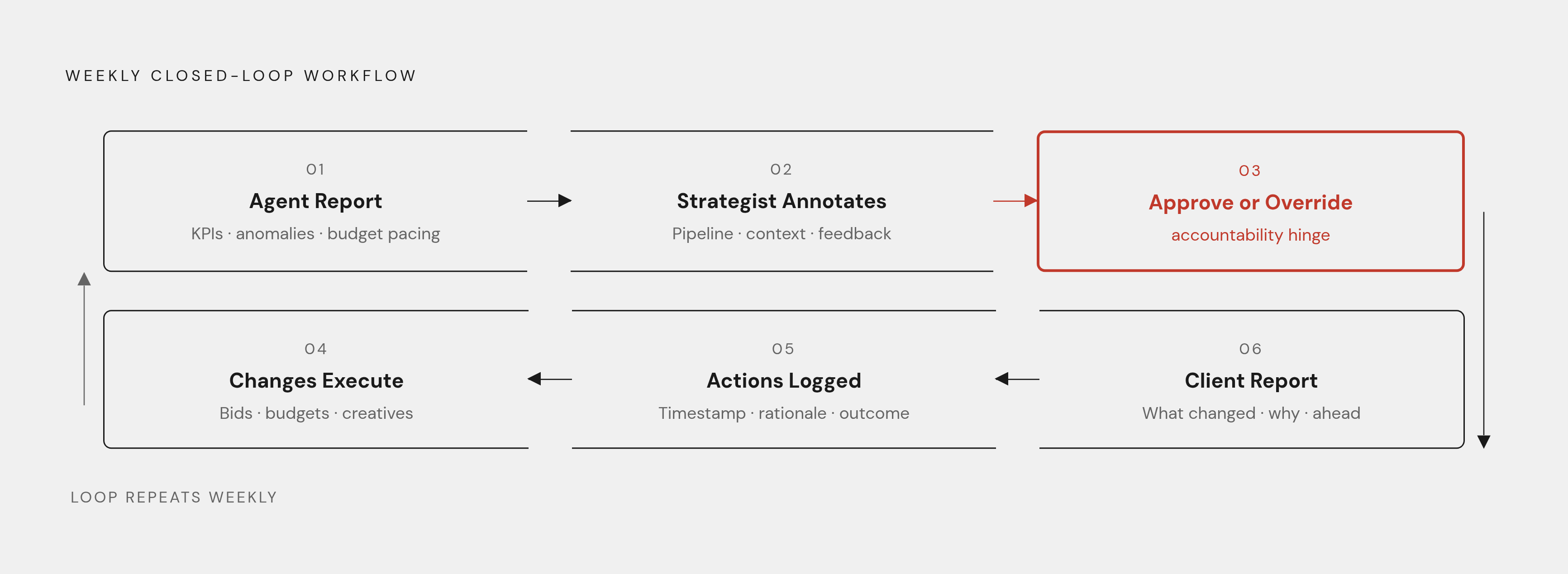
The weekly loop begins with a proactive report. It brings together KPI performance, flagged anomalies, budget pacing, completed actions, and pending recommendations before the strategist’s review. The strategist adds pipeline updates, context on competitors, and client feedback, then approves or overrides the proposals waiting for review before the spending changes go through. The client receives that annotated account of what changed, why it changed, and the priorities ahead.
Every agent action, human approval, and override should be logged with its timestamp, rationale, and outcome, so the account history connects each decision to an approval or an authored governance rule. The strategist’s job has shifted from clicking through Campaign Manager to designing the system that clicks through Campaign Manager correctly.