MCP Tool Selection for B2B LinkedIn Advertising Judged by Creator Agency Workflow Fit
LinkedIn has no official MCP server, so agencies must test connectors.
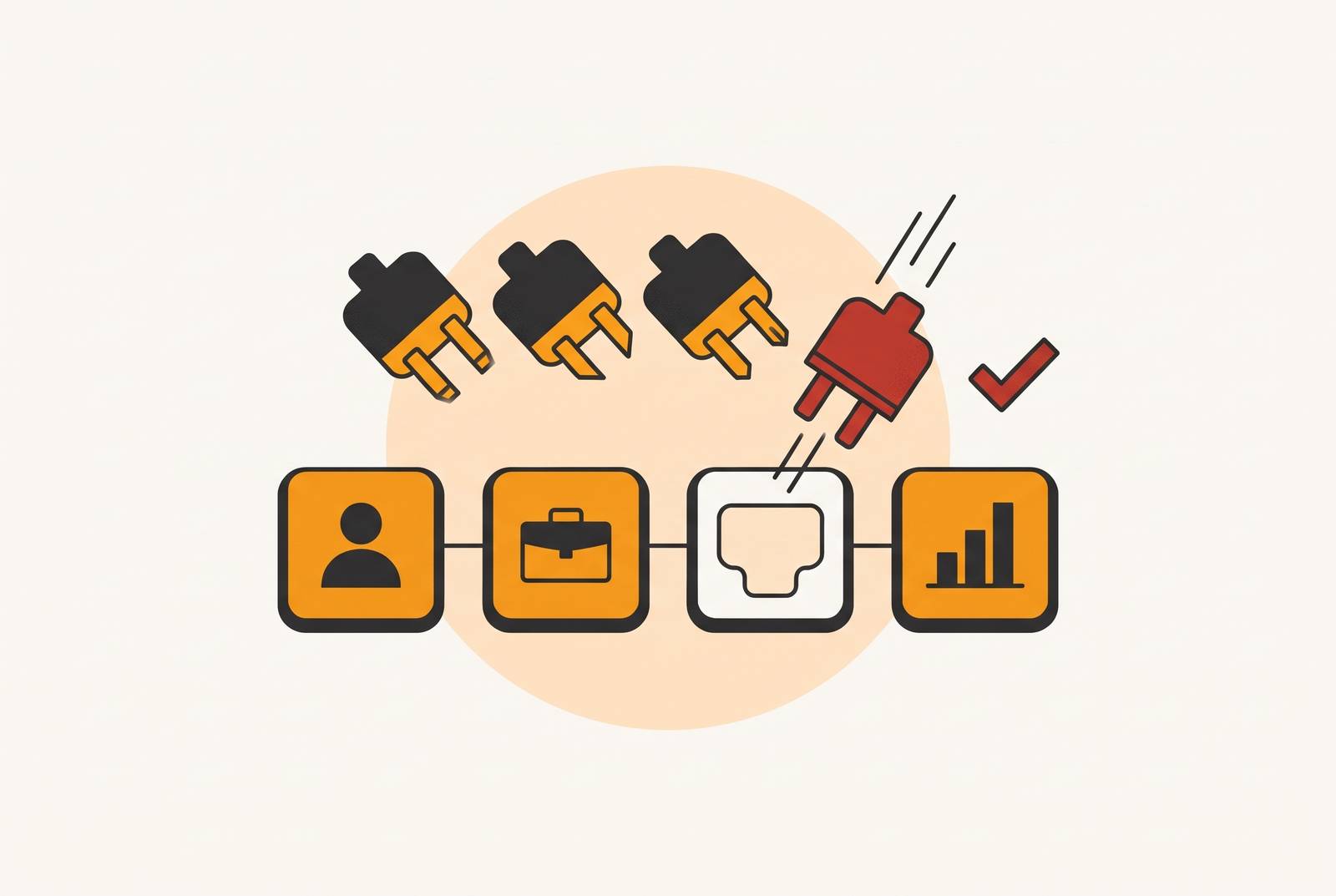
LinkedIn Ads MCP selection is a workflow-fit decision. LinkedIn has no official first-party MCP server, so agencies must evaluate third-party connectors such as Synter and Markifact, with LinkedIn-specific tools filling gaps. The right mix gives strategists and copywriters the data they need, keeps approval gates in place for campaign changes, and links ad results to client revenue.
Why MCP tool selection for LinkedIn B2B advertising is a workflow-fit problem, not a feature problem
Most MCP comparisons count platforms, API endpoints, and write capabilities. Those checks describe breadth. In a creator agency, a strategist queries audience data, a copywriter pulls creative variants, and an account manager approves budget changes. They share an AI-augmented process, but they should not share the same authority. A tool that makes one role faster can obstruct another or give it more control than it should have.
A tool’s fit with the team’s work depends on who uses it, when they use it, and what they can change. A connector might make campaign reporting easy while leaving creative handoffs manual. Another might support writes without separating the person proposing a change from the person approving it. A feature count shows neither problem, but both affect whether the agency can use the tool safely across client accounts.
The structural condition that shapes every LinkedIn MCP decision: no official first-party server exists
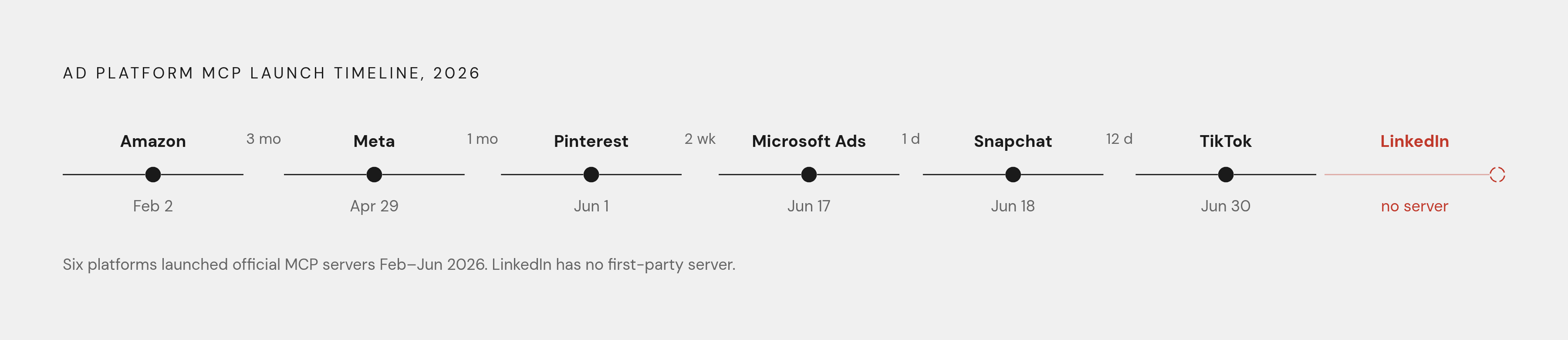
Amazon opened its read/write beta on February 2, 2026, and Meta opened its open beta on April 29, 2026. Microsoft Advertising said on June 17, 2026 that it was opening a pilot. Pinterest announced its alpha partner program that day, after the alpha began on June 1, 2026. Snapchat announced MCP access for third-party AI agents on June 18, 2026, and the rollout will be complete on July 25, 2026. TikTok announced its MCP and launched Agentic Hub with direct MCP connectivity by June 30, 2026.
This is a timing gap. It does change the connection architecture, though. Agencies cannot assume that LinkedIn Campaign Manager has the same first-party agent interface that other platforms have. Actions they cannot execute still require a human in Campaign Manager, so a shared AI workflow does not automatically mean a fully automated LinkedIn workflow.
What MCP actually changes in an agency workflow before any LinkedIn-specific tool is chosen
An MCP server exposes advertising capabilities as tools that an MCP-compatible AI client can call through structured requests. The AI handles the conversation and reasoning. The server turns requests into API calls, handles authentication and rate limits, and sends back structured results. Instead of navigating dashboards, someone can ask to see ad sets that spent more than $500 this week with ROAS below 2.0. Amazon Ads’ read/write beta shows how teams are moving from dashboards to campaign orchestration.
The decisive distinction is what happens after the answer. A read-only server can retrieve performance data but cannot change a campaign. Google Ads’ official open-source server follows that model, preventing accidental campaign edits. Approval-gated writes and autonomous writes create very different responsibilities for an agency, especially when junior staff have access.
With Hosted OAuth, users have much less work to do to manage their credentials. Self-hosting gives the agency more control over data sovereignty but adds IT work. These choices address access and operation, leaving creative quality and attribution to be evaluated separately. A connector can be easy to authenticate and still fail to fit the rest of the agency’s process.
The four workflow requirements that distinguish a creator-agency evaluation from a generic one
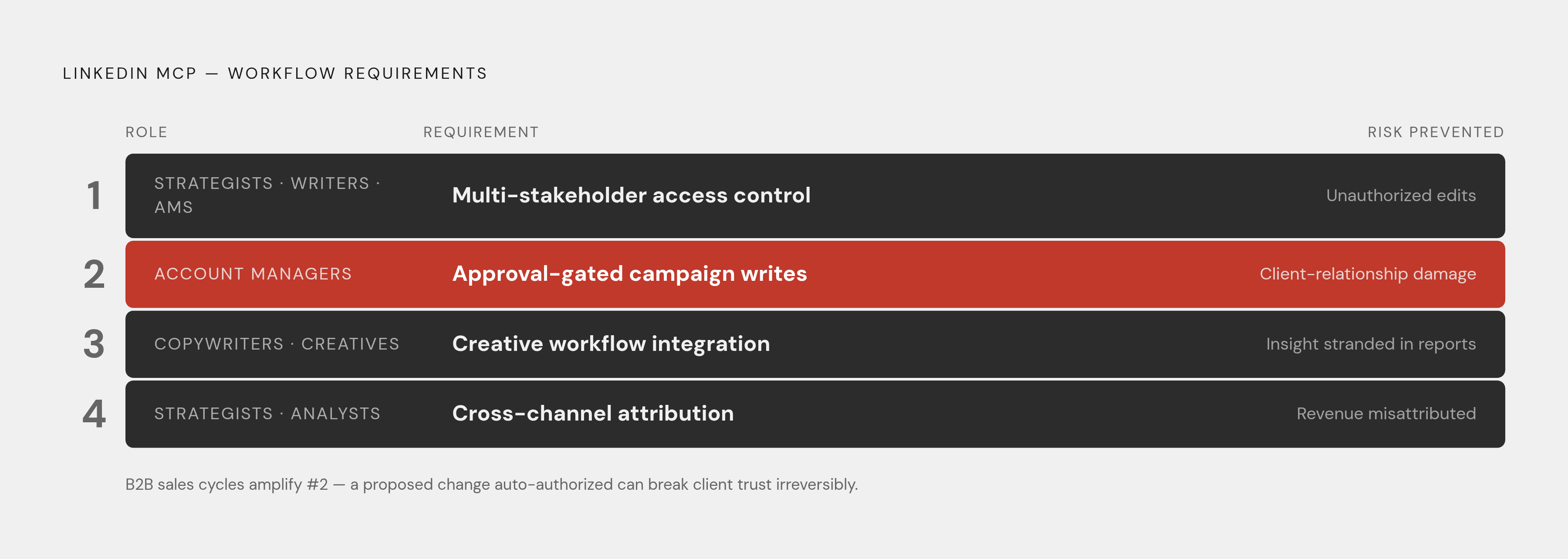
The first requirement is multi-stakeholder access control. Strategists, copywriters, and account managers need different permissions. Hosted OAuth can make authentication easier for the team, while setting up a token for each user adds work as more people join. But easy sign-in is not proof of role-differentiated access. The evaluation must establish both how people connect and what each person can do.
The team also needs approval-gated campaign writes. Someone’s ability to ask for a budget change should not automatically authorize it. This distinction is especially important on LinkedIn, where mistakes can compound over a longer B2B sales cycle. The third requirement is creative workflow integration. Campaign insight needs a route into briefs, landing pages, or ad variants, rather than ending in a report that someone must manually translate for the creative team.
The fourth requirement is attribution outside platform self-reporting. B2B buyers go through LinkedIn, Google, and content touchpoints before they bring in revenue. Each platform’s own conversion claims tell only part of that shared journey. Independent attribution therefore tests something different from reporting breadth. Together, these four requirements form the checklist for the tools below, including where a product covers only one part of the process.
What MCP servers exist for LinkedIn advertising, and where do multi-platform connectors stop?
Synter represents the multi-platform connector approach to LinkedIn API orchestration. Its SOLO plan costs $20/month or $200/year, SCALE costs $500/month or $5,000/year, and CUSTOM is sales-led. For an agency, the multi-account architecture must support different permissions for different roles. SCALE is presented as a plan for teams, but that leaves open how per-seat access works.
The remaining criteria need the same scrutiny. LinkedIn write coverage and approval gates require evidence specific to LinkedIn. Creative integration and independent attribution also need their own evidence. A connector’s ability to retrieve campaign data does not establish that it can turn that data into a brief or explain revenue across channels. These are separate jobs within the stack.
Markifact positions its own offering as a cross-platform advertising MCP. That makes it another candidate for the broad connection layer. It deserves the same tests as Synter, including access architecture, approval-gated writes, creative handoffs, and attribution. The supplied capability details do not establish a winner between them. The practical distinction is between a connector that unifies access and a wider tool combination that supports the agency’s complete process.
LinkedIn-native and B2B-specific tools that fill the gaps multi-platform connectors leave
6sense Revenue AI adds predictive intelligence, intent signals, buyer-stage insights, and automated campaign delivery to LinkedIn ads management. Its role is to connect delivery to customer behavior rather than rely only on platform-defined audience proxies. It fits enterprise B2B teams where intent changes which accounts to reach and when. Its added complexity and cost may be less suitable for growth-stage clients, and its targeting role does not establish team permissions or approval controls.
SegmentStream addresses a different gap, namely attribution beyond platform claims. It connects multiple data feeds and operates on the client’s own cloud data warehouse, keeping data in that environment. Its hosted OAuth approach reduces per-user credential management, while approval-gated campaign writes support supervised optimization. Its Marginal Analytics feature includes geo-holdout incrementality testing. That separates incremental contribution from correlated conversions, which is useful when long sales cycles let last-touch attribution overcredit bottom-funnel channels.
HubSpot MCP supplies the revenue context for those decisions. It exposes pipeline stages, contacts, deals, companies, and tickets through the shared AI workflow. Connecting those records to campaign data lets the team distinguish conversions from opportunities and closed revenue. The combination is the point. Independent attribution can help show what advertising contributes, while pipeline data gives the team a business outcome to aim for through optimization. Neither function, however, proves that the brief-to-creative handoff is covered, so the creative integration criterion remains a separate test.
Competitor ad intelligence as a creator-agency input, and which tools cover LinkedIn
Teams should research competitors when they work on the brief and strategy, before they build the campaign. LinkedIn Ad Library is a free starting point for looking at competitor creative, but it has no spend estimates or frequency data. That makes it useful for benchmarking. Its place in the framework is as a research input. It does not replace a campaign connector, approval controls, or independent attribution.
GetCrux covers competitor ad monitoring and creative intelligence across Meta, TikTok, Google, YouTube, LinkedIn, X, Snapchat, and other channels. That breadth suits agencies studying B2B competitors beyond LinkedIn alone. Foreplay addresses the next handoff by supporting saved competitor ads, ad-library searches, tracked examples, and references turned into briefs. Its pricing starts at $49/month. Its brief-generation capability fits the creative integration criterion because it connects research to production rather than leaving references in a separate collection.
GetCrux explicitly includes LinkedIn in the supplied coverage, while Foreplay’s described value here is its creative workflow. Neither description establishes campaign write permissions or revenue attribution. There is also a firm boundary around spend claims. No free tool provides exact competitor ad spend on LinkedIn or any other platform. Semrush and SpyFu produce directional search-spend estimates from keyword data, and clients need to understand that these figures are estimates.
Agentic performance monitoring and the trust architecture creator agencies need to let AI act on campaign data
After launch, the question shifts from who builds the campaign to who can supervise changes. Agentic monitoring needs a record of every automated action, including its trigger, confidence, and rollback path. Without that record, account managers cannot oversee what the AI does on client campaigns. Alerts and actions are not the same permission. A rule that flags low ROAS or excessive frequency can support supervision, while autonomous budget reallocation creates client-relationship risk.
Creative monitoring also needs to reach the right person. Element-level analysis breaks an ad into its hook, frames, copy, audio, and CTA, then scores those elements against the client’s winners. That can flag fatigue earlier than a weekly review. More importantly for workflow fit, it can direct a copywriter toward an underperforming headline instead of sending a campaign-level ROAS alert that an account manager must diagnose. This capability needs to be verified for each named connector.
Ads for Agents: Measuring Ad-Serving MCP Servers examines a separate trust issue, namely paid ads inserted into MCP tool results and whether their disclosures reach users. The paper by Shahrooz Pouryousef, Sohini Chakraborty, Ali Montazer, and Muoi Tran was submitted to arXiv on 21 Nov 2026. It found ads in a small share of the endpoints and packages examined, so its findings do not justify treating all MCP tools as ad-serving systems. The study also finds that the ads it saw were poorly disclosed and calls for per-item ad annotation. The agency due-diligence question is whether a vendor’s results contain paid placements and whether users can see those disclosures independently of the model’s answer.
Applying the workflow-fit framework: how to map these tools to the creator-agency team structure
The selection process should begin with workflow stages and roles. A strategist needs read access to cross-platform performance and competitive intelligence at the brief stage. SegmentStream supplies an independent attribution layer, while LinkedIn Ad Library, GetCrux, and Foreplay serve different research and briefing needs. This is a read-only starting point. It lets the agency test how useful that access is before letting the tool change client campaigns.
Copywriters need to check that they can use the insights to produce creative. Foreplay’s reference-to-brief workflow meets part of that need, and element-level performance analysis can help pinpoint what to change in later revisions. The account manager’s test is different. Campaign changes need approval, revenue context, and a clear account of what the tool can actually execute. HubSpot supplies pipeline context, while a connector such as Synter handles API orchestration without removing the need to identify manual LinkedIn actions.
For an agency putting this into practice, those manual actions should be explicit steps in the approval workflow. The team should then weigh hosted and self-hosted access based on how much work credentials take and how much control it needs over data. Read-only, approval-gated write, and autonomous write access should match what each role has the right to do. The evaluation concludes by assessing creative integration and independent attribution separately from platform coverage.
A tool that fails one role’s permission test is a workflow-fit failure, however long its feature list.