TikTok Ad Creative Testing Framework for Brands
Isolate one variable per ad so every test teaches you something.

TikTok ad creative testing is a system for learning which hooks, messages, and formats turn attention into sales. As the platform automates targeting and bidding, brands gain more control through disciplined creative tests than through campaign tinkering.
Why creative has become the primary performance lever on TikTok
TikTok’s Smart+ removes targeting decisions that once gave advertisers room to distinguish their campaigns. Launched in Q4 2024 and fully mature in 2026, it automates bid strategy, creative selection, and audience expansion. Advertisers supply the campaign and goal while the system handles more of the delivery choices. That leaves fewer manual levers to pull. On TikTok, performance differences now concentrate in creative volume and diversity, conversion signal quality, and budget structure.
The same shift extends beyond TikTok. Meta’s Andromeda retrieval system reads creative signals to match ads to people. Google is auto-migrating advertisers using campaign-level Broad Match or Automatically Created Assets to AI Max starting September 2026. Across these systems, advertisers still control the creative, even as the systems take over more of the targeting.
More variants give TikTok more opportunities to find an audience, and brands outperforming benchmarks run more creative variants per month than those falling behind. But volume alone is not a strategy. A winning ad provides a temporary signal rather than a durable asset, so it needs a predictable replacement schedule. The gap between brands that sustain high creative volume and those that cannot is a systems gap.
What makes TikTok creative structurally different from other platforms
TikTok serves people actively searching for answers and people discovering products they did not expect to find. Creative therefore has to work in both modes. An approach borrowed from Meta or a video-sharing platform has to account for how people watch, because someone who comes from search and someone who follows an algorithmic rabbit hole expect different things.
Users recognize professionally produced content that signals “advertisement” and scroll past it, while native, creator-style content performs better on engagement. TikTok optimizes for watch time percentage, completion rates, rewatch or loop rate, comment engagement quality, and share or save rates. Those signals favor content that feels at home in the feed, with creator-style presentation, audio usage, and trend integration ranking above production budget, celebrity endorsements, and prominent logos. Native aesthetics are therefore a testing variable.
The variable isolation principle: why most creative briefs fail as testing instruments
A brief written for brand consistency asks what the brand wants to say. A testing brief asks what the team wants to learn. When a new hook, visual, CTA, and offer all change together, a winning result cannot explain which change helped. The team has an asset it can scale, but no clean basis for cloning its success.
The discipline is to isolate one variable per asset. Useful axes include hook format, such as talking head, text overlay, or POV, and angle, such as problem-agitate-solve, social proof, or a contrast demo. Talent can be a founder, customer, or creator, and a test of offer framing can compare dollar savings with a percentage or free gift. Each brief should identify its variable, predict the direction of the result, and connect that prediction to observed buyer behavior. Customer reviews, sales calls, and direct messages are better places to start than what the team prefers.
That connection makes the hypothesis useful. When buyers worry about price, that points toward an offer test, while confusion before they buy points toward a hook test. Still, in today’s algorithmic campaigns, it is not always possible to change just one variable. In those structures, different core messages in separate ad sets can produce readable angle-level signals even when smaller creative elements vary. The practical rule is to read the angle first, then judge the individual asset.
The hook as the first and highest-leverage test variable
The first three seconds decide whether viewers stay to see the rest. A strong body or offer cannot help when the opening loses attention, which makes the hook the first variable to test and the one to refresh most frequently. Hook rate, or three-second view rate, is a better predictor of scaling potential than CTR. Most of the highest-performing ads put their core message inside that opening window. The opening earns the rest of the ad.
Different hooks earn attention in different ways. Options include a bold question, pattern interrupt, controversial claim, social proof teaser, before/after reveal, a soft-sound or sensory opening, and direct address. None is a universal winner. Their performance depends on the vertical and offer, so a hook test needs a buyer-based hypothesis.
For beauty and personal care, close-up application, natural lighting, real skin texture, and authentic reactions outperform polished brand imagery. For food and CPG, home or kitchen settings, real cooking or consumption, and genuine taste reactions outperform studio food photography. Once an opening wins, its fatigue signal is specific. If six-second view rate falls more than roughly 15% week-over-week while CTR stays stable, the hook is fatiguing. Replace the opening while retaining the proven body and CTA.
The 3-5-3 method: a structured approach to testing hook, angle, and CTA combinations
The 3-5-3 method organizes three hook variations, five value proposition angles, and three CTA styles into a testable set of combinations. It is not a production quota. In practice, the team selects six to ten priority combinations based on its hypothesis.
This combination test serves a different purpose from a strict single-variable test. It helps surface promising combinations faster, while angle-level analysis keeps the interpretation grounded. All variations launch at the same time in the same ad group with the same share of the budget, and TikTok finds the top performers within a set impression window per ad. A winning combination provides evidence at the combination level.
The body still has to retain the attention the hook wins. What viewers see should change every one to two seconds through quick cuts, text overlays, or transitions. The CTA should match the campaign goal, with “Shop Now” for eCommerce, “Learn More” for consideration, and “Sign Up” for lead generation. Each creative needs one core message and one primary action.
Budget belongs in the test design. Six creatives running at the same time need enough spend each day to get a signal within five to seven days. An underfunded test is inconclusive. Friday evening through Sunday is a cheaper time to launch because TikTok weekend delivery tends to have lower CPMs.
The metrics hierarchy for scoring creative and making kill-or-scale decisions
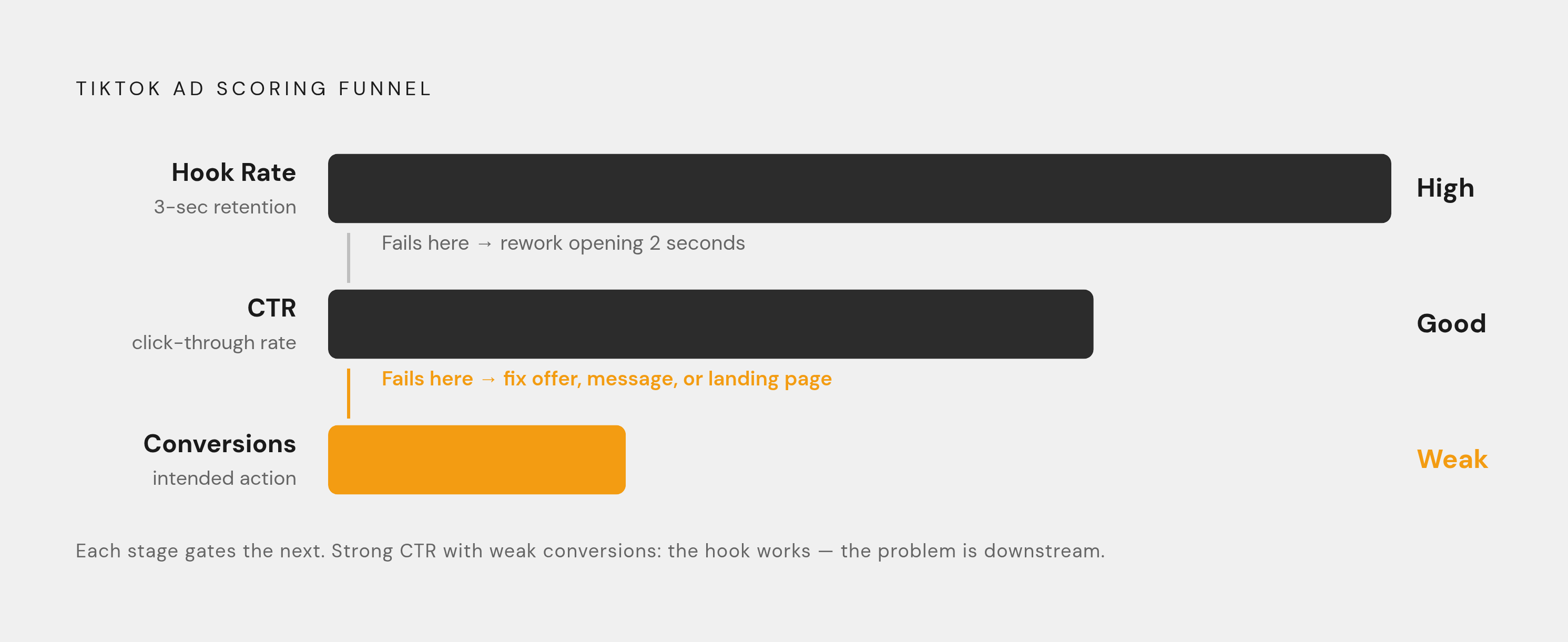
A single KPI cannot diagnose the whole ad. Hook rate should first exceed the platform benchmark for distribution potential, because weak early attention limits what the rest of the creative can achieve. CTR then helps show whether that attention turns into interest, while conversions show whether people go on to take the intended action.
Strong CTR with weak conversions points downstream. The hook and body are doing their job, so the offer, message, or landing page needs attention.
Kill and scale decisions also need rules set in advance. Pause underperformers after seven days once they have reached the defined spend gate. Select the two to three creatives meeting all thresholds for scaling, then increase budgets in increments where the signal is strong. Large jumps can destabilize the algorithm’s learning.
Post-purchase surveys surface TikTok-influenced buyers that pixel attribution misses, and brands using them consistently find a larger TikTok footprint than in-platform ROAS suggests. Those surveys broaden the picture without replacing the creative scorecard.
The weekly operating cadence that keeps the testing system running
A weekly rhythm turns the framework into an operating system. Monday is the scorecard review, when the team pauses underperformers that have reached their spend gate without meeting benchmarks. It also flags creatives that are close to frequency fatigue and keeps frequency under roughly 2.5. Decisions begin with evidence. That review gives the next batch of briefs a reason to exist.
Tuesday and Wednesday are for writing and assigning those briefs with a five-day turnaround. Each brief follows the variable isolation standard and bases its hypothesis on the buyer signals and test results the team already has. Thursday shifts attention to current winners, with a scale review and incremental budget increases where the evidence is strong. The schedule separates learning from production without disconnecting them.
Friday is for creator intake, quality checks against the brief hypothesis, uploading to Ads Manager, setting spend gates, and launching into weekend delivery. The batches overlap rather than starting and finishing inside one calendar week. A brief assigned on Tuesday or Wednesday with a five-day turnaround is not the batch due that Friday. Teams can adapt the calendar while maintaining a steady rhythm.
That overlap also applies to the refresh cycle. New tests begin by Week 4, ahead of the fatigue that arrives at Week 9+, so fresh creative enters before existing winners run out. A winner’s wall keeps a lasting record of the patterns behind winning ads alongside the finished ads. Brez, a non-alcoholic beverage brand that scaled significantly in 2025, credited its winner’s wall as its most valuable creative tool. The case illustrates a brand-specific output of a running system.
How top-performing TikTok creative travels across channels
A TikTok winner becomes a candidate for Meta testing. Reformatted for Instagram placements with small edits, it brings a proven hook and angle into a different distribution environment. The logic is straightforward. A hook that wins with a sound-on audience, a native aesthetic, and a short attention window has faced demanding conditions, though that does not guarantee the same result elsewhere.
The format can travel with the message. UGC-style creative that wins on TikTok also tends to outperform branded content on Meta, so TikTok reinforces a cross-channel preference. As results accumulate, the winner’s wall becomes a cross-channel pattern library. It shows teams which angles, offer framings, and hook types have won across channels, so they can use what each test taught them beyond its first placement.
What AI agents and automation tools can handle in a structured testing system
AI agents can take on repeatable work in creative generation, performance monitoring, and scale decisions. But they do not remove the need for test design. The team still has to set the hypothesis and variable isolation logic, because producing more assets does not by itself produce a readable result. Automation is useful when the rules explain what to generate, what to measure, and when a decision needs review.
TikTok launched its own MCP server in May 2026, giving connected AI assistants a way to work with it. Advertisers using an assistant connected to TikTok’s API can issue natural-language instructions and have changes executed and made available for approval. This moves some campaign work from manual controls into instructions, but it does not settle whether the requested change answers the test’s question.
Synter manages campaigns across 27 advertising platforms through AI agents or MCP integration, including TikTok, Meta, Google, LinkedIn, Reddit, and X. Its tools let teams create campaigns, report on performance, optimize budgets, and generate creative. That cross-channel reach creates a governance risk as well as an operational benefit. Agents reason about situations they were not explicitly programmed for, so failures can propagate across platforms simultaneously. Human review of spend gates and kill signals should not be fully delegated, even when the routine work is automated.