How TikTok Ad Agencies Source UGC Creators
Agencies pair creator vetting, briefs, and Spark Ads to beat ad fatigue.
TikTok ad agencies source UGC creators through a repeatable pipeline. They find and vet creators, brief them, test their work, and use the results to decide what comes next. Sustained performance depends less on finding one standout creator than on having a system ready when the winning ad wears out.
Why TikTok's creative environment makes a repeatable sourcing pipeline necessary
TikTok handles most of how ads reach an audience automatically, so creative is the main thing advertisers control. UGC fits that environment because it supplies the things the platform rewards, including vertical video, fast hooks, native lighting, and real voices. But that fit does not give any asset a long working life. Creative fatigue arrives far faster than on Meta, compressing testing cycles from quarterly to weekly.
An agency cannot spend its effort polishing one asset and expect it to carry the campaign for long. It needs different creator assets ready to take over when the current work starts to perform worse. The pressure is therefore on both quality and supply, because good creative that arrives after fatigue has set in leaves the same gap as no creative at all.
The three supply chains agencies run simultaneously to keep creative volume up
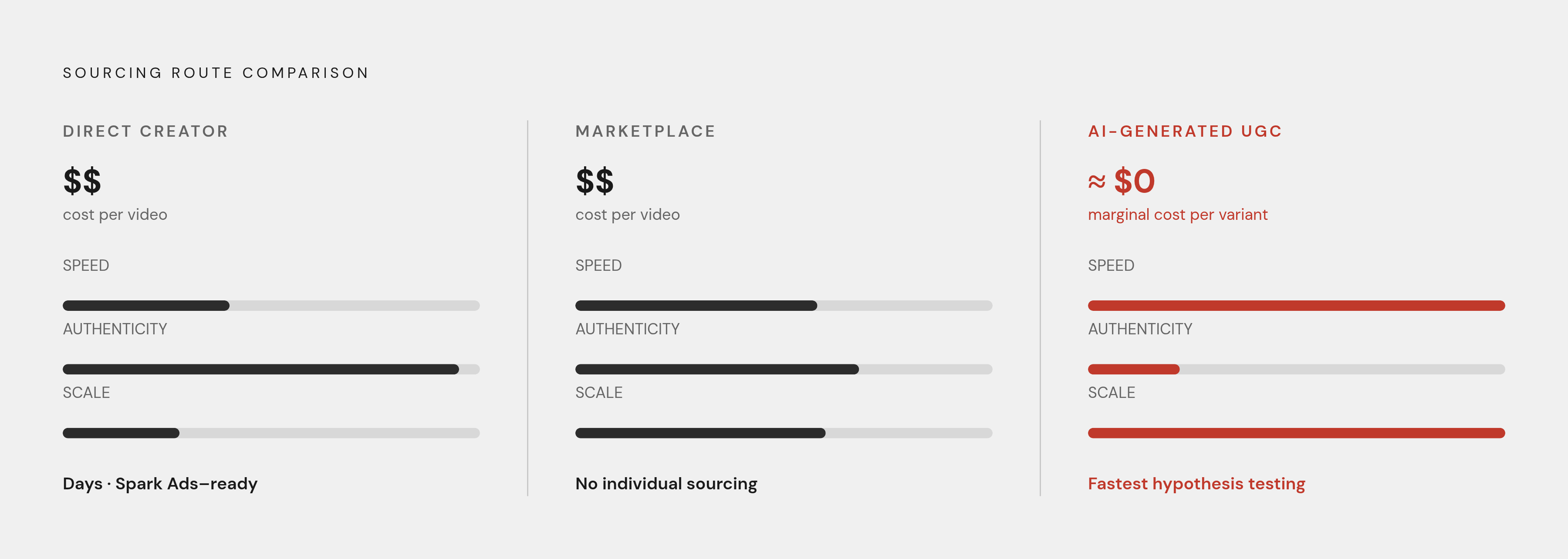
Agencies run three supply chains, namely direct creator outreach, marketplace sourcing, and AI-generated UGC. Direct outreach means commissioning a creator to film against a brief. It offers authentic delivery and feeds a Spark Ads pipeline directly, but turnaround takes days and each video carries a meaningful cost at scale. Marketplaces, including TikTok's own Creator Marketplace and third-party UGC marketplaces, remove the need to source every creator individually. They still need a production budget because each video costs about as much as it does through direct outreach.
AI-generated UGC serves a different part of the cycle. For photo-mode and carousel formats, agencies can generate creative from product images and copy without a creator or filming. The marginal cost of another variant is close to zero, which makes it useful for rapid hypothesis testing. These routes serve different purposes, and the strongest pipelines sequence them. Relying on only one limits either testing speed, access to creators, or authentic delivery.
Why nano-influencers are the workhorse tier for direct creator sourcing
For direct outreach, agencies prioritize nano-influencers because engagement rates and cost-per-asset economics favor many small creators over one large name. Modest video pricing makes it feasible to commission a roster at the same time instead of putting the budget behind a single endorsement. That roster supplies different content styles and access to different micro-communities. It also builds social proof through a range of credible voices.
inBeat Agency runs a vetted network of more than 120,000 creators, matched by category, audience, and content style. It makes several UGC variants for each campaign, tests them against each other in Spark Ads, and draws on the network to replace losing variants while scaling winners. The network is therefore a replenishment resource. The objection that nano-influencers lack reach confuses production with distribution. In a Spark Ads workflow, paid amplification supplies reach, while the creator supplies a credible asset that feels at home on TikTok.
How agencies vet creators before they enter the pipeline
A large roster is only useful if its members pass a consistent filter. Agencies check whether audience demographics and geography match the brand's target market, then look at whether the creator's posts feel native to TikTok. They also look for category or adjacent-category experience, which reduces the direction required and the number of unusable takes. As skit-based and narrative-driven UGC displaces simpler formats, delivery matters more. A creator may need comedic timing, natural on-camera presence, and the ability to carry a conversion-focused script in the same asset.
Vetting also checks whether creators follow FTC disclosure rules and how well they have followed sponsored content rules in the past. With their own networks, agencies can hold the whole roster to those standards instead of depending on whoever an open marketplace has to offer. Access to harder-to-find profiles, including male 35-plus creators, fintech and SaaS specialists, and creators for non-English-speaking markets, can distinguish one network from another. Those differences matter when a brand expands beyond its existing audience. A well-vetted roster makes output more predictable and lets the brief direct the work.
How agencies write briefs that produce usable assets without over-directing creators
The brief must be firm about the message without scripting away the reason to hire a creator. Effective briefs specify the hook structure, product claim, and call-to-action format while leaving the creator's voice, setting, and on-camera behavior largely open. Too much direction strips out the native feel. Too little can produce work that needs expensive reshoots or cannot be used in paid media. The balance is strategic, because it defines what the test is meant to learn and what the creator is free to interpret.
Voice-of-customer research and analysis of a competitor ad library give that direction a firmer basis than what the brand assumes in-house. They ground hook language and objections in buyer behavior. Agencies then brief multiple angles at once, so testing compares messaging hypotheses. Commissioning several creators from the same brief adds natural variation in tone, environment, and delivery without separate creative development for each asset. Usage rights, raw file delivery, and whitelisting terms also belong in the brief agreement, because negotiating them after delivery slows paid activation.
How Spark Ads connect the creator sourcing pipeline to paid media amplification
Spark Ads turn sourced content into paid distribution through the creator's own handle. The ad inherits the post's real engagement and social proof before paid spend amplifies it. Spark Ads get higher click-through and conversion rates than non-Spark equivalents, and their CPA is 30-40% lower than that of standard In-Feed Ads. The inherited social proof is important.
A sourced creator films against the brief, the brand receives raw files and Spark Code authorization, and the media buying team amplifies the highest-performing posts. Underperforming variants are retired and replaced from the network. inBeat Agency's campaign for Hopper used this approach to counter rapid ad fatigue, casting top-fit creators and scripting variations around proven angles. The pipeline kept replenishing the supply while Spark Ads amplified winners.
House of Marketers' campaign for Jodel recruited more than 60 TikTok micro-influencers over three to four months across Germany, France, and Sweden. It used Spark Ads to amplify high-performing posts while meeting strict acquisition targets. That connection must work in both directions. The people sourcing and briefing creators need visibility into winning ads so the next brief reflects the results.
Where AI-generated UGC fits in the pipeline and where it doesn't replace human creators
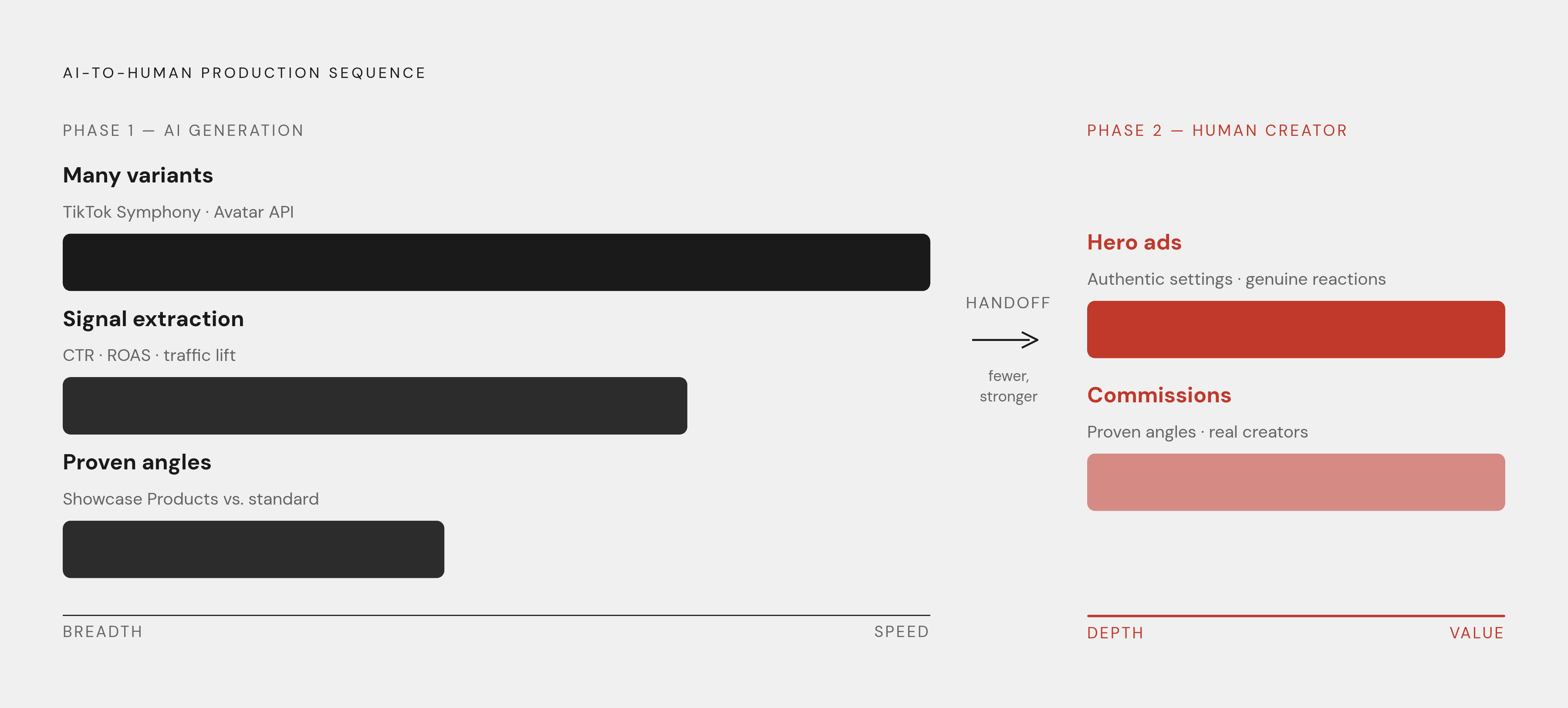
AI-generated UGC belongs earlier in the testing sequence, where breadth and speed matter most. TikTok's Symphony Creative Studio supports a production workflow that includes AI-assisted script generation, thumbnail testing, and automated variant production. The advantage is that more variants can reach testing faster, shortening the gap between a hypothesis and performance data.
Aporia LTD used TikTok's Avatar API and saw a substantial increase in creative output, with improvements in CTR and ROAS compared to its previous approach. American Eagle saw meaningfully higher traffic ROAS with Symphony's Showcase Products feature than with standard campaign assets. Those examples support a role for AI in production. Real human creators still tend to make the hero ads that perform best, where real settings, genuine reactions, and non-scripted pacing matter. The practical sequence is AI for early testing breadth, followed by human commissions for proven angles that need authentic delivery at scale.
How agencies measure creative performance to know which creators to replenish and which angles to repeat
Once assets go live, volume needs a measurement layer or the pipeline cannot improve. Views, likes, and shares do not reveal which hook drove a conversion or which creator demographic produced the lowest customer acquisition cost. Stronger agencies track results at the hook, angle, and creator-segment level. That detail separates an execution problem from a messaging problem. Without it, an agency can replace creators when it should revise briefs, or repeat an angle whose apparent success came from something else.
The distinction changes the next sourcing decision. If a creator consistently earns strong hook completion rates but weak conversion rates, the brief probably needs adjustment. If the content underperforms across all metrics, the creator exits the roster. Brighter Click uses proprietary tracking tools to identify which hooks, angles, and demographics drive sales, turning the findings into brief revisions. Each cycle therefore starts with evidence from the last one.
Variant-level measurement also matters when an agency works across platforms, though their mechanics differ. Meta's Andromeda algorithm update makes this more complex through its Entity ID and Creative Similarity systems, where ads that look alike compete against each other. A poorly differentiated batch can suppress its own performance in ways a campaign-level aggregate misses. That is a Meta-specific mechanism, but it reinforces the broader measurement point. The agency needs enough detail to know what to change.
How agencies replenish and scale the creator roster without losing quality control
Measurement becomes a lasting part of the work when the agency keeps a standing roster. The vetting work is done once per creator, while briefing knowledge accumulates as the agency learns which creator types work for each brand vertical. Creator relationships, vetting standards, and the brief library last beyond any single campaign. The next production cycle builds on them, saving the cost of setting up the same things again. That continuity is what makes the operation repeatable.
The Social Shepherd's Beyblade X campaign for Hasbro added tens of thousands of TikTok followers and generated millions of organic video views in six months at a strong engagement rate. Output at that scale calls for creator relationships beyond one-time sourcing. But expanding the roster also creates a quality-control risk if volume targets weaken entry standards. Tiered rosters address that tension by giving proven performers hero briefs and new entrants lower-stakes testing briefs. For international growth, geographically diverse and multilingual networks extend the same principle, making new market entry possible without rebuilding the sourcing infrastructure.
What to look for when evaluating whether an agency's pipeline will actually sustain performance
“UGC agency” can mean a freelancer marketplace or a full performance creative operation, so the label tells a brand little. The useful evidence is how the operation connects its parts. Network size matters together with vetting rigor and access to hard-to-find profiles. Sourcing and media buying should also be connected closely enough that Spark Ads activation does not stall at a handoff.
The terms of the deal show whether the agency is selling files or helping paid ads perform. Usage rights and whitelisting should be included by default. A replenishment plan should explain how underperforming creators are replaced and new angles arrive before fatigue sets in. Warning signs include case studies that report only campaign-level aggregates, no account of how results change sourcing, and pressure to sign a long-term contract before the first creative is delivered. An unclear answer about who manages the account day-to-day is another gap between the sales pitch and the operation.
A brand needs to know what happens if the campaign's top-performing creative fatigues in two weeks, and who does the work next. A genuine pipeline has an answer that connects the roster, the next brief, production, and paid activation. A production-only service has another asset to deliver, but not necessarily a system to sustain results.