MCP Integrations a Creator Agency Should Audit Before Committing to a B2B Paid Social Stack
With no official LinkedIn Ads MCP, agencies must vet third-party write access.
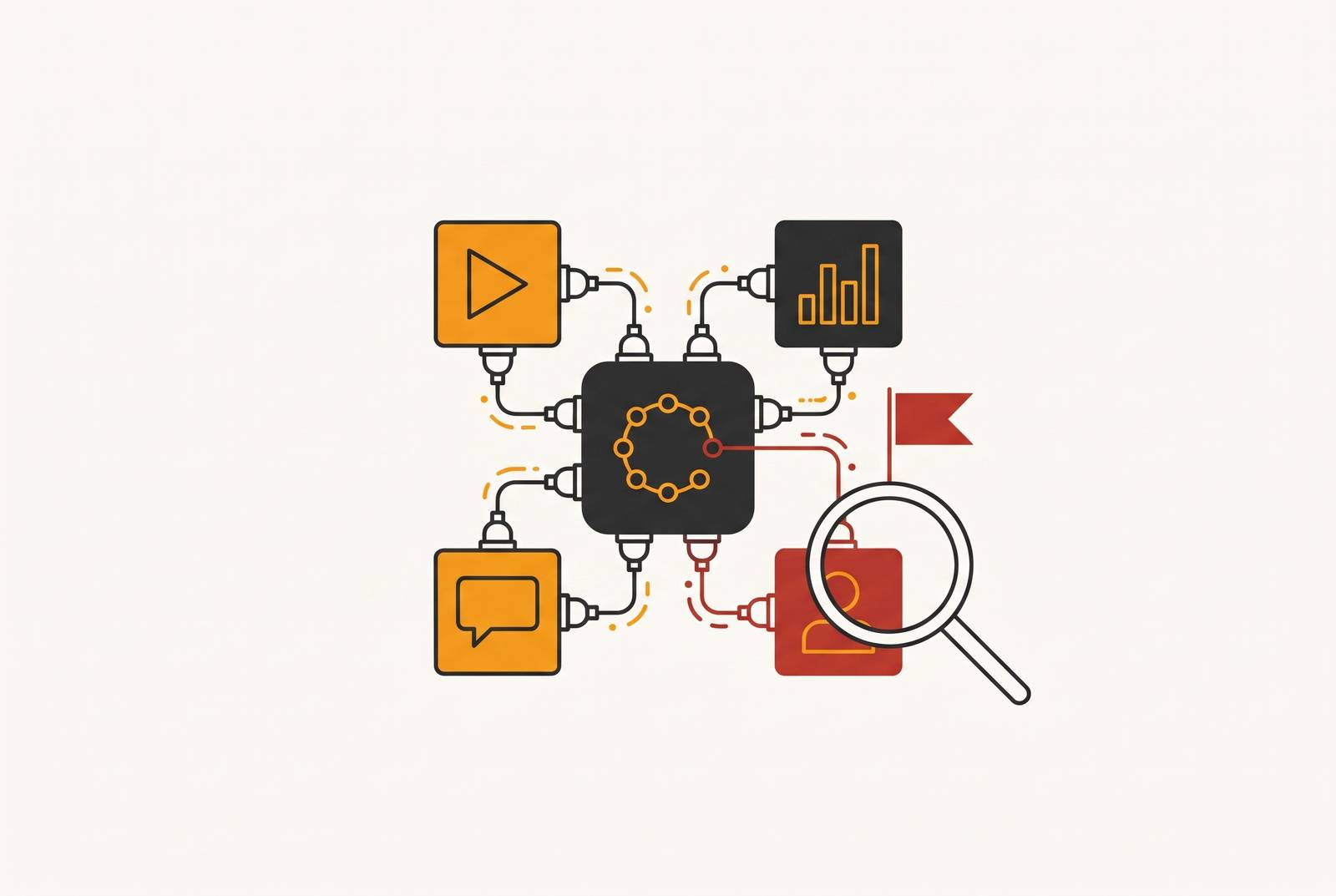
As of November 2, 2026, no official LinkedIn Ads MCP server exists. Synter Media and Supermetrics offer third-party routes for AI assistants to create LinkedIn campaigns, but their write depth and approval safeguards need separate scrutiny. Before committing to a B2B paid social stack, a creator agency should audit write access, audience targeting, LinkedIn coverage, and agent safety rather than treat “MCP integration” as proof of a complete workflow.
Why MCP integrations have become a structural choice, not a feature comparison
Anthropic created Model Context Protocol, or MCP, in November 2024 as an open standard for connecting AI agents to external tools and data. It gives compatible clients, including Claude, ChatGPT, Cursor, and custom agents, a common interface to compatible services. That removes the need for custom integration code for each platform. The protocol standardizes the connection. What an agent can do still depends on the tools and permissions each server exposes.
For paid social operations, that distinction separates an assistant that explains results from one that changes campaigns. An agent can connect to several MCP servers simultaneously, working across platforms and saving a media buyer from switching tabs. Production servers already work with real ad spend for thousands of businesses. This is no longer just an experiment. Choosing a stack now therefore means choosing the MCP integrations that govern how an agent can operate it.
The four criteria that make an MCP audit meaningful for B2B paid social
Write access depth is the first test. The audit needs to establish whether a server can create, update, pause, and delete campaigns, or only read data and produce reports. “Write access” alone is too broad a label because support for one operation does not establish support for the others. A read-only server may make analysis faster while leaving campaign work to be done by hand. The audit needs to show the exact boundary between what the agent can do and what still needs to be done in the platform interface.
Audience targeting fidelity tests whether that boundary also cuts through campaign quality. The agency needs to establish which targeting parameters the tools expose, including custom audiences, lookalikes, demographics, and firmographic signals. A reduced parameter set may force precise targeting back into the platform interface. Because LinkedIn is typically the highest-intent channel for B2B creator agencies, missing support creates a manual exception where end-to-end operation is most valuable.
Responsible use of those capabilities requires agent safety controls. The audit needs to examine paused-by-default creation, two-step confirmation, permission scoping, and audit trails, rather than accept a general promise of human oversight. These are prerequisites. The four criteria follow a practical order, moving from whether an agent can act to what it can target, whether it reaches LinkedIn, and what constrains its actions. Every server needs the same checks, including connectors that claim to cover a wide range of channels.
What the official platform MCP servers actually enable today, channel by channel
Meta Ads MCP launched on April 29, 2026, with read and write access. It can create campaigns, change budgets, and update status, but every object an agent creates starts paused and needs a human to activate it. Its audience tools include custom audience creation, lookalike generation, and audience size estimation. The toolset leans toward commerce and catalog operations, however, with less emphasis on B2B firmographic targeting.
The server requires ads_mcp_management plus either ads_management or ads_read, with ads_management required for writes. That distinction is enforced through OAuth permissions. The official launch followed reports of account restrictions involving unofficial connectors accessing the Marketing API in ways Meta had not sanctioned. Agencies that manage client accounts need to check whether access is sanctioned as well as whether a connector works.
Google Ads MCP is open-source under Apache 2.0 and has no MCP fee. It can run locally with pipx or on Google Cloud Run, and getting full value requires GAQL knowledge. Google’s developer token page states that developer tokens were sunset on September 9, 2026, and are no longer required. It works best for search and Performance Max reporting. The audit should distinguish that reporting role from any supported write workflow rather than treat the server alone as a complete autonomous campaign operator.
Amazon Ads MCP became available globally in open beta in February 2026 to Amazon Ads partners with active API credentials. It is relevant to agencies with e-commerce or SaaS clients on Amazon, but less central to pure LinkedIn and Meta B2B workflows. X Ads MCP launched in August 2026 to connect LLM agents and custom agents built on MCP SDKs to X Ads tools. The audit still needs to spell out each server’s write depth, targeting parameters, and approval safeguards.
TikTok introduced its Ads MCP at TikTok World 2026 in May. It announced the server with TikTok Ads Skills covering campaign creation, performance insights, creative analysis, audience discovery, and budget optimization. That makes it relevant to agencies with consumer-facing clients, though it is more relevant to B2C than B2B work. The distinction between announced skills and exposed MCP tools remains important. The audit needs to establish which operations and safeguards the server itself provides.
LinkedIn is the break in this first-party picture. As of November 2, 2026, it has no official LinkedIn Ads MCP server. LinkedIn Hiring Pro, its official MCP connector that launched in October 2026, covers only job posting. It does not fill the advertising gap. B2B campaign operations need third-party connectors for an MCP-based workflow because first-party LinkedIn coverage and write access are unavailable.
What MCP servers can connect an AI agent to LinkedIn Ads, and what do they trade away?
Synter Media offers LinkedIn campaign creation through Claude Desktop, Cursor, or any MCP client. It also supports channels including Google Ads, Meta Ads, TikTok Ads, Reddit Ads, and Microsoft Ads, and claims 100+ MCP tools with direct API connections and no middleware. It is for running campaigns across channels as well as reporting on them. The LinkedIn-specific tool boundary still needs inspection. An agency should confirm which LinkedIn tools can write and which only read, rather than infer full management from a supported-platform label.
Supermetrics has included campaign_create and campaign_update tools for LinkedIn Ads since April 2026. Those tools also cover Google Ads, Meta Ads, Microsoft Ads, and TikTok Ads, while Pinterest, Amazon, and Reddit Ads remain read-only. Its reporting-first design makes campaign-level work the relevant starting point for comparison. Deep audience management is a separate question. Agencies that depend on precise LinkedIn audience operations should audit the exposed parameters rather than assume campaign creation includes the targeting controls they need.
Connecting an agent through either option also means checking how the vendor handles authentication and what its permissions allow. Neither listed connector has the same OAuth-gated, platform-enforced model as Meta’s official server, so the agency needs to check whether it can review writes before they run. Connector setup is not just a connection task. The audit must distinguish permission to access an account from permission to change campaigns or spend budget, without assuming that one vendor’s safeguards exist in another.
These connectors solve a real coverage problem, but they introduce a vendor dependency between the agent and the advertising API. Synter’s direct-connection claim does not remove dependence on its API approval status, rate limit management, or maintenance cadence. First-party servers avoid that extra connector-vendor dependency, though this does not make every first-party integration complete. Pricing also belongs in the comparison without being mistaken for capability. The choice is a risk-managed tradeoff between usable LinkedIn coverage and the additional layer the agency must trust.
Where Meta's Andromeda update changed what MCP audience targeting actually delivers
Meta’s Andromeda re-evaluation of audience signals through Q1–Q2 2026 changed how MCPs handle audience targeting and reporting. This makes a tool list an incomplete account of targeting fidelity, including for audits conducted after the official server’s April 29 launch. B2B campaigns on Meta often depend on custom audiences and lookalikes built from CRM data or high-value customer lists. If the weighting or reporting of those signals changes, an agent may optimize against a different picture from the one the agency intended.
The audit therefore needs a maintenance cadence. Agencies should compare audience size estimates and performance reporting from MCP-mediated campaigns with Ads Manager directly for the first several weeks after deployment. Meta’s 29-tool list cannot show that the tools still work the same way underneath. The same checks are needed when another platform changes audience modeling, attribution, or reporting logic. Re-checks after these platform updates test whether the data the agent uses still matches the platform’s native view.
Agent safety controls are the audit criterion agencies most consistently underweight
A write-access audit answers whether an agent can change an account. A technically complete integration can remain unsuitable for deployment if its changes exceed acceptable limits. A prompt asking an agent to seek approval is a weaker guarantee than a platform rule that prevents execution without it. Agencies need to identify where the constraint lives.
Meta’s paused-by-default behavior puts one constraint at the platform level. Campaigns and ads created through its MCP remain paused until a human activates them, rather than relying on an agency to configure that behavior. Google Ads MCP’s “Propose & Confirm” workflow uses a different model, with a dry run followed by a confirmation call containing a checksum. Two separate calls are required for that write workflow. The checksum prevents replay or modification between proposal and confirmation, but the workflow does not by itself establish comprehensive campaign-management coverage.
Third-party connectors usually lack those platform-enforced guardrails, so safety depends more on agent instructions and the agency’s prompt engineering. Permission scoping deserves equal attention because it limits what the agent is authorized to do before any instruction is considered. Meta’s three-tier model distinguishes read-only, read/write, and read/write/financial access. Maximum access is not a sensible default. Agencies should check that scope is limited to what is needed and keep financial operations separate and subject to human approval.
Audit trails complete the safety check. Agencies need to establish whether the server records what the agent did, when it acted, and which parameters it used. Without that record, reconstructing a campaign change and documenting it for a client becomes unverifiable. The starting rule is concrete. Connect every new MCP integration read-only, validate its data against native reporting, and then expand to writes while keeping budget and bid changes behind human approval until lower-stakes operations demonstrate reliability.
What a structured MCP audit produces that platform marketing never will
The audit’s output is a channel-by-criterion matrix. For each channel, it records write depth as full, limited, or read-only, and targeting fidelity as a full parameter set, reduced access, or reporting-layer only. It also records whether LinkedIn coverage is first-party, third-party, or unavailable, and whether safety controls are platform-enforced, configuration-dependent, or absent. Those distinctions make the comparison defensible. They prevent a reporting connection from being treated as equivalent to campaign management with enforced approval controls.
A stack with official Meta, Google, and TikTok servers but a third-party LinkedIn connector has a B2C-first architecture with a B2B workaround. The agency should state that arrangement clearly, without ruling it out by default or hiding it behind a claim of broad coverage. A unified platform can reduce the burden of handling separate integrations, but only if its shared layer meets the same audit criteria.
The finished comparison also needs a maintenance commitment. Agencies should plan re-checks when platforms announce changes to models or algorithms that affect targeting or attribution. The defensible choice is the integration whose capabilities, dependencies, and limits the agency can specify before an agent receives authority to act.